
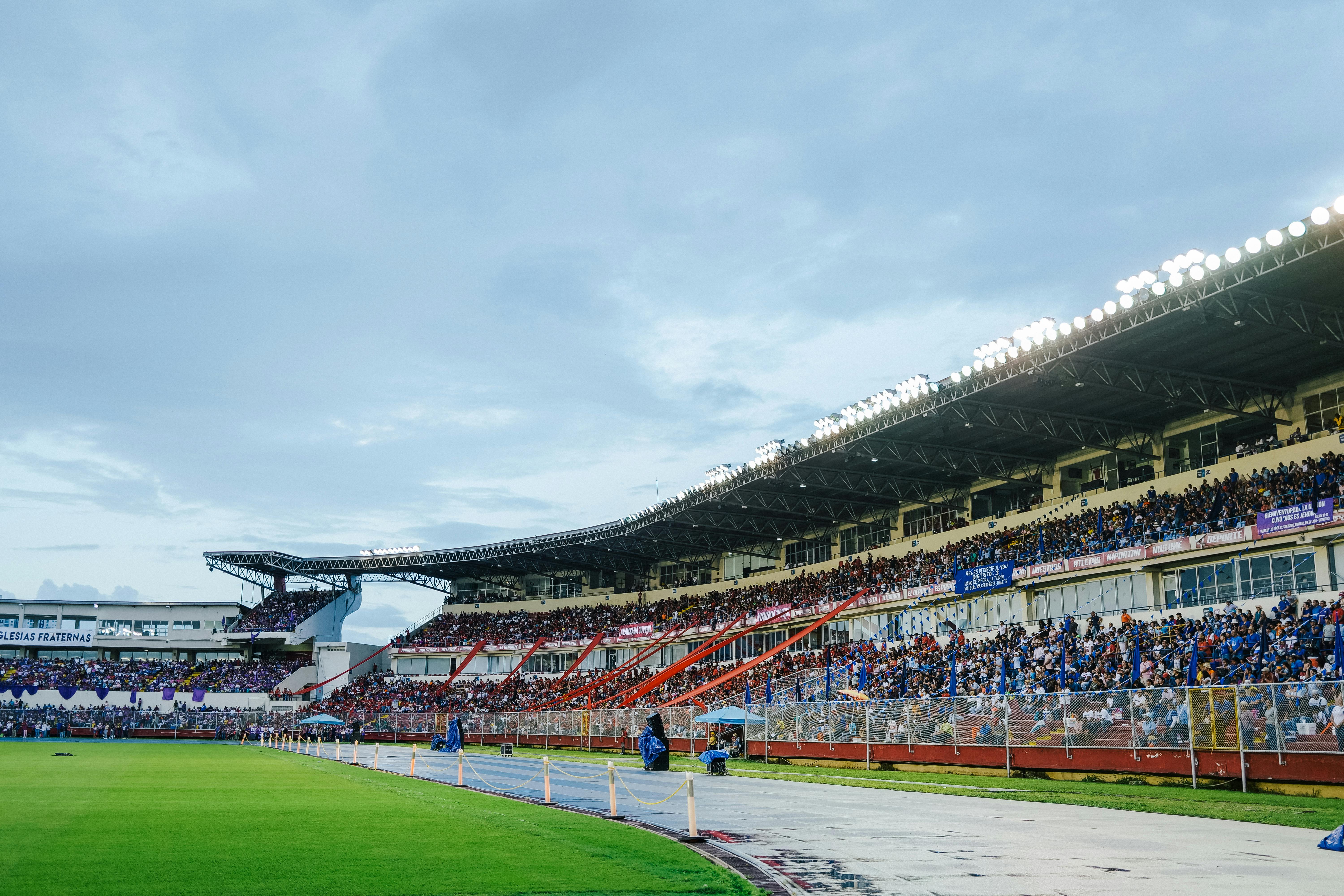
A pitch that hosts matches and training through winter would be mud by December under natural conditions. Keeping it playable is a continuous engineering operation rather than routine gardening.
The soil is engineered, not natural
A modern pitch is built on a deep sand-dominated rootzone laid over gravel and a network of drainage pipes.
Sand drains rapidly and resists the compaction that closes up natural soil under repeated impact, so water leaves quickly and air still reaches the roots.
The trade-off is that sand holds neither nutrients nor moisture, which is why such a pitch depends on constant irrigation and feeding to survive at all.
Synthetic fibres hold the surface together
Most major stadium pitches are hybrid surfaces, with fine synthetic fibres stitched into the rootzone at close spacing across the whole area.
Natural grass roots grow around those fibres, and the combination resists tearing far better than grass alone, particularly in goalmouths and other heavily used areas.
The visible surface remains grass, and the reinforcement only becomes apparent where the turf is worn down to the level of the stitching.
Stadiums block the light the grass needs
A modern bowl with a high roof puts much of the pitch in permanent shade during winter, exactly when daylight is already shortest.
Grass cannot grow without light, so grounds staff move rigs of growth lamps across the surface on a rotating schedule to give each area its required hours.
Ventilation systems are used for the same reason, since a sealed bowl traps humid air over the surface and encourages disease that would otherwise be dispersed by wind.
Recovery is scheduled around fixtures
Every match damages the surface, and the work between matches is timed to whatever gap the fixture list allows.
Divots are replaced immediately after play, the pitch is aerated to relieve compaction, worn areas are reseeded, and the surface is fed and cut to a consistent height.
Where the gap is too short for recovery, the damage carries into the next match, which is why congested periods visibly degrade a surface.
Non-match use is the hardest test
Concerts and other events place staging and flooring over the grass for days, cutting off light and air entirely.
Grass deteriorates rapidly under cover, so such events are concentrated in the closed season and the schedule is built around how long the surface can be covered.
Where damage exceeds what recovery can repair, sections of turf are replaced outright, which is why pitches are sometimes relaid mid-season.